

Reduced fertilization can enhance natural pest control without lowering crop yields
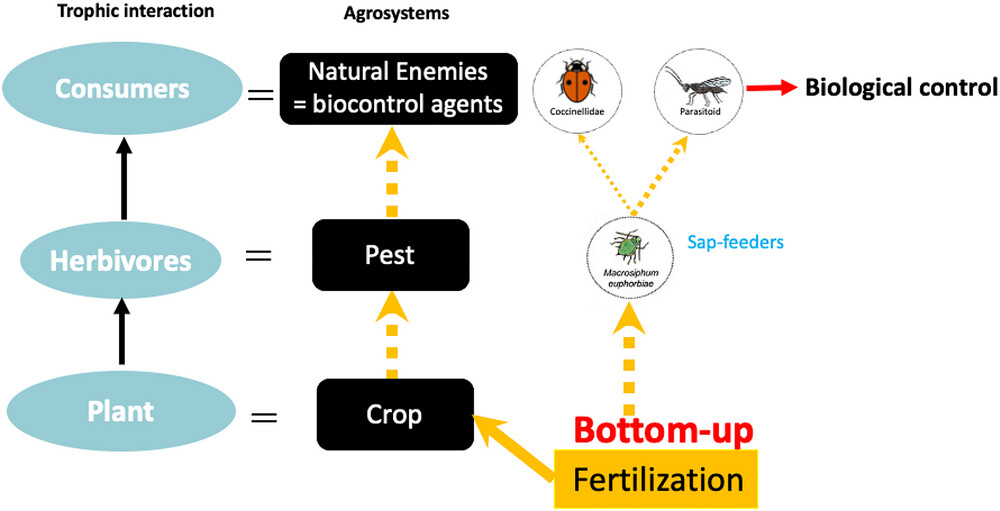
This schematic illustrates the “bottom-up” effects of fertilization on agricultural ecosystems. Increased nutrient input enhances crop growth, which in turn supports herbivorous pests such as sap-feeding aphids. These pests are then targeted by natural en
New study shows optimised nutrient use supports sustainable agriculture and strengthens biological control
BEIJING, CHINA, April 22, 2026 /EINPresswire.com/ -- A study published in Insect Science reports that reducing fertilizer input can improve natural pest control without compromising crop yields, challenging the assumption that higher nutrient use is always beneficial in agriculture.Led by Prof. Anne-Violette Lavoir and Nicolas Desneux, with first author Ruohan Ma, the research examined how fertilization levels affect interactions between tomato plants, aphids, and their natural enemies. In greenhouse experiments, the team compared high and moderate fertilization regimes and measured plant growth, pest populations, and biological control performance.
High fertilization increased plant biomass but also accelerated aphid population growth. In contrast, moderate fertilisation slowed pest development, while crop yield remained largely unchanged.
“Our findings show that more fertilizer does not necessarily mean better outcomes for farmers,” the researcher said. “By slightly reducing nutrient input, it is possible to maintain crop yields while enhancing natural pest control.”
Background
Modern agriculture has long relied on synthetic fertilizers, particularly nitrogen, to maximise productivity. However, excessive nutrient input can make plants more attractive to herbivorous insects, increasing pest pressure and encouraging greater pesticide use. This can negatively affect beneficial organisms and reduce ecosystem stability.
Effects on biological control
The study found that fertilization influences biological control agents differently. The parasitoid Aphidius ervi, which develops inside aphids, was sensitive to plant nutrient conditions. Although more abundant under moderate fertilization, its effectiveness declined under high fertilisation levels.
By contrast, the generalist predator Adalia bipunctata (ladybird beetle) remained effective across both fertilization regimes, indicating greater resilience to changes in plant nutrition.
“These results highlight the importance of considering ecological interactions when designing fertilization strategies,” the researchers noted. “Agriculture needs to shift from maximising inputs to optimising ecological processes.”
About the research team
This work was conducted by the Multitrophic Interaction and Biocontrol (MIB) team, which focuses on understanding the ecological and physiological interactions between insect pests, their natural enemies, and environmental conditions. The team combines approaches ranging from field and laboratory experiments to molecular biology and multiomics to develop innovative and sustainable biocontrol strategies for future agroecosystems.
Conclusion
The findings suggest that fertilization is a key factor shaping both pest dynamics and the success of biological control. Adjusting nutrient input to align with ecological processes could reduce reliance on chemical pesticides while maintaining productivity. This approach supports Integrated Pest Management (IPM) and offers a pathway towards more sustainable agriculture.
Read the full Article here: https://onlinelibrary.wiley.com/doi/10.1111/1744-7917.70253
Andrew Smith
Charlesworth Publishing Limited
marketing@charlesworth-group.com
+ +44 7478953600
Visit us on social media:
LinkedIn
YouTube
Other
Legal Disclaimer:
EIN Presswire provides this news content "as is" without warranty of any kind. We do not accept any responsibility or liability for the accuracy, content, images, videos, licenses, completeness, legality, or reliability of the information contained in this article. If you have any complaints or copyright issues related to this article, kindly contact the author above.
