

What Is Evidence Marketing? New Framework Says Proof Is the Most Valuable Form of Marketing
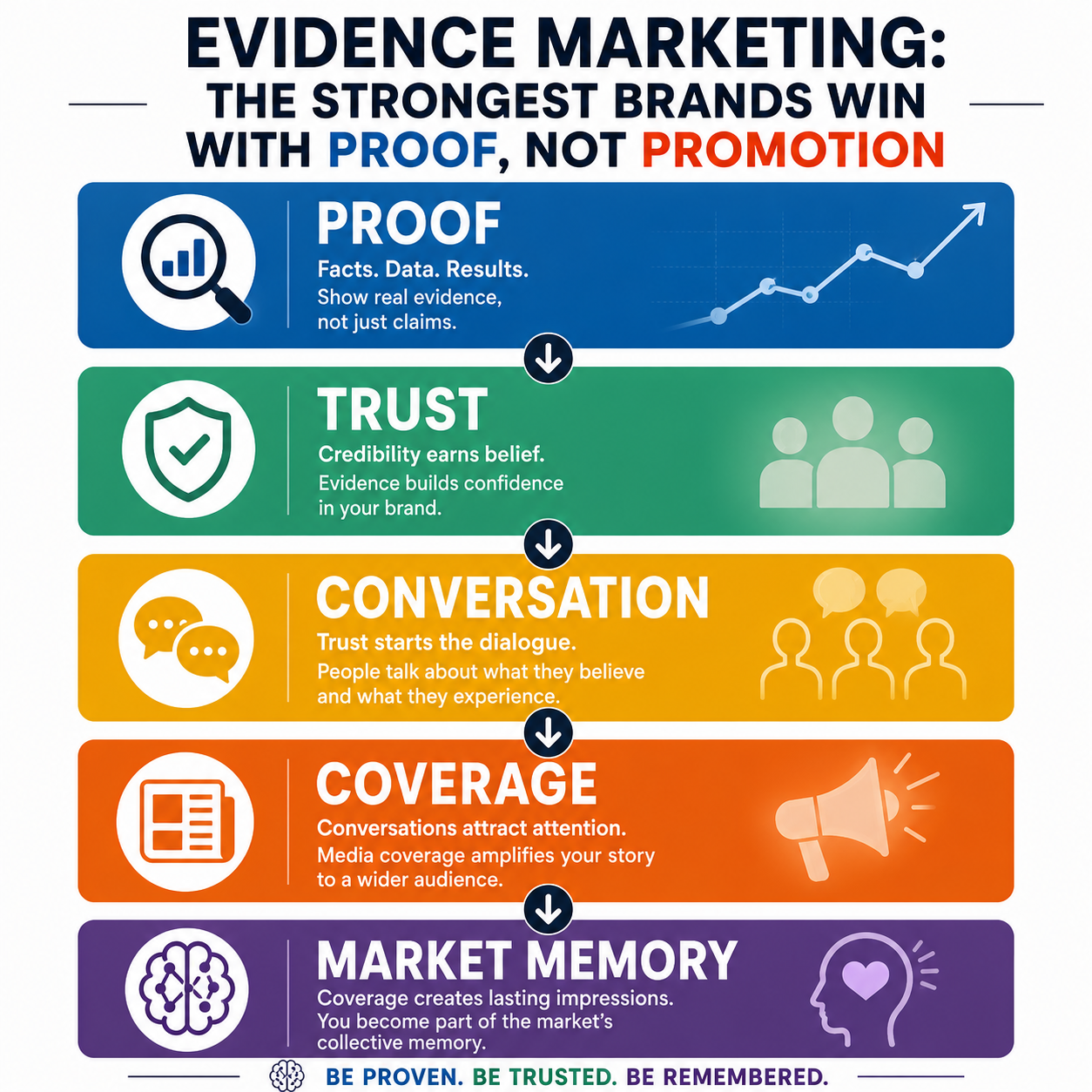
The Evidence Marketing framework illustrates how proof creates trust, trust fuels conversations, conversations generate earned media, and media builds lasting Market Memory that influences both people and AI.
PR strategist Evan White introduces Evidence Marketing, a new framework that argues proof has become marketing's most valuable asset.
What Is Evidence Marketing?
Evidence Marketing is a communications strategy centered on creating verifiable proof rather than promotional claims. Instead of relying primarily on advertising, campaigns, or brand messaging, organizations intentionally create customer stories, original research, conference presentations, earned media, executive thought leadership, demonstrations, educational content, and community experiences that become lasting evidence of their expertise.
The framework was developed by Evan White as part of his broader body of work on Market Memory, which explores how organizations become remembered by customers, professional communities, journalists, search engines, and increasingly large language models (LLMs) that synthesize information from across the public web.
"The next generation of marketing isn't about making louder claims," White said. "It's about creating stronger proof. The organizations that consistently produce evidence, not just promotion, will become the ones people remember, recommend, and trust."
The Shift From Promotional Marketing to Evidence Marketing
For decades, marketing success often centered on broadcasting a message through advertising, websites, campaigns, and search optimization.
Today's buying journey looks different.
A prospective customer may first hear a founder speak at a conference, watch a product demonstration on LinkedIn, listen to a podcast interview, read an earned media article, hear a recommendation from a peer, ask an AI assistant about the company, and only then visit the corporate website.
In many buying journeys, the homepage is no longer the first impression. It is one of the last.
That shift changes the fundamental question marketers should ask.
Instead of asking:
"What should we say?"
Organizations should increasingly ask:
"What evidence are we creating?"
What Counts as Evidence?
Evidence Marketing expands the definition of marketing beyond promotional assets.
Examples include:
* Customer success stories supported by measurable business outcomes
* Independent research, benchmarking, and industry reports
* Conference presentations and keynote sessions
* Earned media coverage from trusted publications
* Executive interviews and podcast appearances
* Product demonstrations and educational videos
* Community events that generate authentic conversations
* Awards, certifications, and analyst recognition
* Open-source projects, educational resources, and public expertise
* Customer testimonials supported by real-world implementation stories
Each of these becomes another independently discoverable signal that contributes to how a company is understood over time.
What Evidence Marketing Is Not
Evidence Marketing is not simply another name for content marketing, public relations, advertising, or demand generation.
Those remain important disciplines.
Evidence Marketing is the strategic approach that aligns them around a single objective:
Create proof that others choose to reference.
Rather than asking every activity to generate immediate conversions, Evidence Marketing asks whether that activity strengthens the organization's long-term reputation, credibility, and discoverability.
The Seven Principles of Evidence Marketing
1. Proof beats promotion.
People trust evidence they can verify more than claims companies make about themselves.
2. Third-party credibility compounds.
Customer stories, journalists, analysts, conference organizers, creators, and professional communities all strengthen credibility in ways self-promotion cannot.
3. Experiences create stronger memories than campaigns.
The moments people attend, participate in, and discuss often outlast the advertisements they consume.
4. Every piece of evidence compounds.
Research leads to media. Media leads to speaking invitations. Speaking creates customer conversations. Customer success creates new stories. Credibility grows through accumulation.
5. Community creates credibility.
Organizations become memorable when people voluntarily discuss their work, not simply because companies publish more content.
6. AI increasingly understands organizations through evidence.
As AI assistants synthesize information from public sources, organizations with richer bodies of credible, interconnected evidence become easier to understand and explain.
7. Evidence creates Market Memory.
Every customer success story, conference presentation, interview, demonstration, media article, and educational resource contributes to the collective memory that the market develops about an organization.
The Evidence Marketing Framework
White describes Evidence Marketing as a compounding communications system rather than a campaign.
Unlike traditional campaigns that conclude after launch, each new piece of evidence strengthens every piece that came before it, creating an expanding body of public proof that competitors cannot easily replicate.
Why This Matters in the AI Era
Generative AI has changed how organizations are discovered.
Rather than reading a single webpage, AI systems increasingly synthesize information from multiple public sources to answer questions about companies, industries, executives, products, and trends.
That means organizations are increasingly represented by the total body of evidence available about them, not simply by the messaging they publish themselves.
"The internet remembers evidence better than advertising," White said. "People do too."
Five Predictions for the Next Decade of Marketing
White believes Evidence Marketing will become a defining communications strategy over the coming years.
He predicts:
* Marketing budgets will increasingly invest in creating evidence alongside advertising.
* Conference speaking and community participation will be recognized as measurable marketing assets.
* Customer stories will become more valuable than promotional copy.
* Communications teams will be evaluated on the quality and discoverability of proof they create, not simply impressions or media mentions.
* Organizations with stronger bodies of public evidence will be easier for customers and AI systems to understand, trust, and recommend.
Building a Body of Work
Evidence Marketing is one component of White's broader research into how organizations build lasting visibility in an AI-driven world.
That body of work includes concepts such as Market Memory, The Reputation Graph, The Visibility Flywheel, The New PR Funnel, and the idea that the corporate homepage is increasingly becoming the final destination in the buying journey rather than the first.
Together, these frameworks argue that the future of communications belongs to organizations that create memorable experiences, verifiable proof, and trusted third-party signals that compound over time.
About Evan White
Evan White is a communications strategist and founder of Evan White PR. His work focuses on how public relations, executive visibility, conferences, earned media, thought leadership, and community experiences shape long-term Market Memory in the age of artificial intelligence. He develops strategic frameworks that help founders, technology companies, and event organizers build lasting visibility by creating evidence that customers, journalists, professional communities, and AI systems can discover, understand, and remember.
Evan Dennis White
Evan White PR Inc
+1 509-995-9105
email us here
Legal Disclaimer:
EIN Presswire provides this news content "as is" without warranty of any kind. We do not accept any responsibility or liability for the accuracy, content, images, videos, licenses, completeness, legality, or reliability of the information contained in this article. If you have any complaints or copyright issues related to this article, kindly contact the author above.
