

Driving Simulator Market Register CAGR of 7.6% Driving Demands, Technology and Growth Outlook By the Forecast 2026-2035
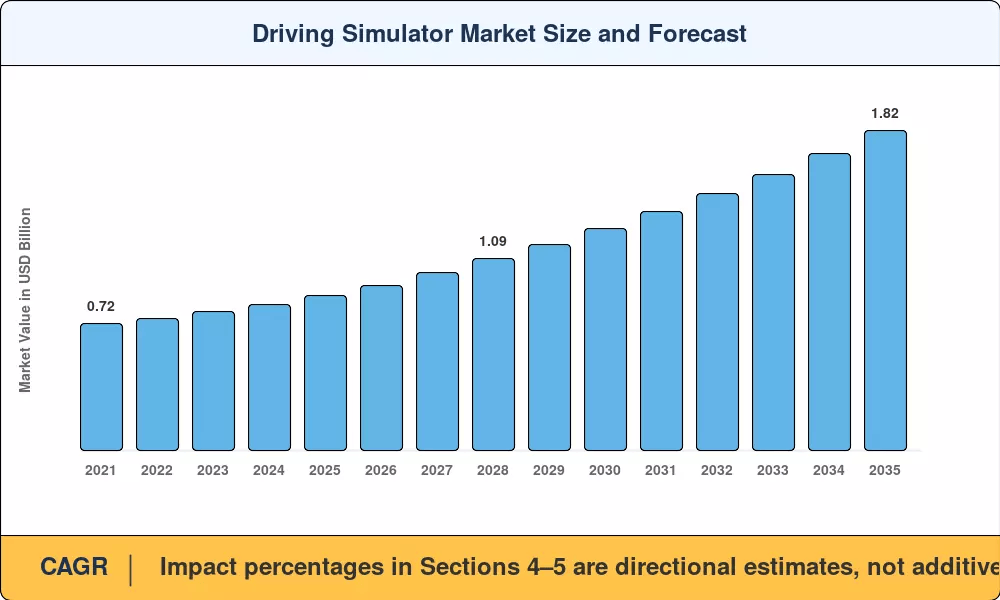
Driving Simulator Market Summary
Passenger cars accounted for 64% of the driving simulator market in 2025, reflecting high volumes of learner-driver and OEM R&D simulation demand.
Training represented 54% of the driving simulator market share in 2025, by driving-school adoption across Europe and Asia-Pacific. Europe led the simulator market with a 39% revenue share in 2025.”
NY, CA, UNITED STATES, July 13, 2026 /EINPresswire.com/ -- The driving simulator market was valued at USD 0.88 billion in 2025 and is projected to reach USD 0.94 billion in 2026 before climbing to USD 1.82 billion by 2035, expanding at a CAGR of 7.6% over the forecast period (2026–2035).— Arti Dhapte
Driving Simulator Market Overview
A driving simulator market trends is an advanced technological system designed to replicate the experience of operating a motor vehicle within a computer-generated virtual environment. These systems combine hardware components such as steering wheels, pedals, motion platforms, and high-resolution visual displays with sophisticated software that models vehicle dynamics, road conditions, traffic scenarios, and environmental factors. Driving simulators serve a diverse range of applications, from basic driver education and professional training to automotive research and development, motorsport engineering, and autonomous vehicle validation. The fidelity of these systems varies considerably, ranging from compact desktop configurations to full-scale, multi-axis motion platforms with 360-degree visual immersion.
The market is experiencing robust growth driven by several fundamental factors. One of the primary catalysts is the pressing need to reduce the expenses associated with physical vehicle testing, as simulators offer a cost-effective alternative to on-road trials and prototype development. Stringent safety regulations are mandating rigorous validation of advanced driver-assistance systems (ADAS), compelling automakers to conduct millions of virtual scenarios to achieve certification. The rapid evolution of self-driving technology necessitates virtual testing to safely manage hazardous 'edge cases' that are impractical or unsafe to stage physically on public roads. Additionally, the urgent need for skilled commercial drivers, driven by e-commerce expansion and logistics growth, is propelling simulator adoption in fleet training programs.
Industry trends indicate a decisive shift toward high-fidelity, immersive simulation experiences. The integration of virtual reality (VR) and augmented reality (AR) technologies is enhancing realism and engagement, allowing users to train in complex traffic situations and hazardous driving conditions that would be difficult to replicate in real life. Digital-twin integration and over-the-air software verification are becoming standard, enabling engineers to shorten iteration loops and probe unreachable scenarios through software-in-the-loop test beds. Cloud-hosted and subscription-based platforms are broadening accessibility in cost-sensitive regions, nurturing new user segments among smaller training centers and research institutions.
Technological developments are reshaping the market landscape. Advanced simulators now incorporate real-time vehicle dynamics models, synthetic sensor feeds for LiDAR and radar, and sophisticated traffic modeling algorithms. Predictive algorithms and telematics integration link in-cab behavior with classroom refreshers, providing personalized training experiences. The development of driver-in-the-loop (DIL) systems, which combine physical motion cueing with immersive visual environments, is expanding the capabilities of research and testing applications. Moreover, the emergence of AI-driven simulators that adapt to driver behaviors and provide real-time feedback is transforming both training effectiveness and vehicle development processes.
Policy and regulatory influence on the driving simulator market is significant. The World Health Organization reports approximately 1.19 million road traffic deaths each year, making simulation-based driver assessment and risk-free scenario training increasingly relevant for governments, automakers, and insurers. Regulatory bodies such as Euro NCAP and the National Highway Traffic Safety Administration (NHTSA) have released protocols that pair track runs with simulation, turning high-fidelity rigs into compliance gates for ADAS and autonomous functions. The European Union's automotive sector invests heavily in R&D, with simulators playing an essential role in meeting stringent safety and environmental standards.
The demand outlook for driving simulators remains strongly positive across multiple sectors. The automotive industry represents the largest end-user segment, leveraging simulators for vehicle development, driver training, and safety testing. Commercial fleets are turning to advanced simulators to shorten recruitment cycles and reduce accident rates, while research institutions and defense organizations employ simulators for human factors analysis and specialized training. The training segment continues to dominate application demand, but testing and research applications are growing at the fastest rate as automakers channel budgets toward software-dominated validation.
📍 Get Free Sample Report for Detailed Market Insights:
https://www.marketresearchfuture.com/sample_request/32260
Driving Simulator Market Segmentation
By Vehicle Type
The driving simulator market is segmented by vehicle type into Passenger Car and Commercial Vehicle. Passenger car simulators account for the largest market share, serving both novice driver education and OEM research and development. The dominance of this segment is attributed to its widespread application in driver training, vehicle testing, and motorsport simulation. Commercial vehicles, including trucks and buses, represent the fastest-growing segment, driven by e-commerce logistics expansion and the need to train qualified commercial drivers. Fleet managers deploy simulators to cut per-driver training costs, keep rigs on the road, and satisfy stricter hours-of-service audits. The commercial-vehicle push stimulates demand for peripheral services including scenario library customization for hazmat routes, multi-language UI overlays, and remote instructor stations.
By Application
Application segmentation divides the market into Training, Testing & Research, and Motor Sports & Gaming. The training segment historically holds a dominant position, driven by entrenched driver-education curricula and corporate compliance needs. Driving simulators provide a safe, controlled environment for learners to practice various scenarios, including extreme weather conditions, hazardous roads, and emergency situations, without real-world risks. The testing and research segment is witnessing the fastest growth, as automakers wanting to shorten release cycles channel budgets toward software-dominated validation where virtual miles are cheaper than track miles. Researchers use simulators to evaluate ADAS performance, test autonomous driving algorithms, and analyze driver behavior under controlled conditions.
By Simulator Type
Simulator type segmentation includes Compact Simulator, Full-Scale Simulator, and Advanced Simulator. Compact simulators dominate the market volume due to their smaller size, affordability, and suitability for local driving institutions and training centers. Full-scale simulators account for a substantial revenue share, widely recognized for replicating real-world driving conditions with remarkable accuracy and heavily utilized in automotive, aviation, and defense industries. Advanced simulators, equipped with features such as 360-degree viewing angles and motion platforms, are gaining traction for professional training and research applications that demand highly realistic experiences.
By End-User
End-user segmentation covers Driving Schools & Training Centers, OEMs & Automakers, Fleet Operators, and Research Institutions & Defense. OEMs and automakers represent the largest end-user segment, leveraging simulators for R&D, vehicle testing, and safety assessments across the vehicle development lifecycle. Simulators enable manufacturers to test vehicle designs, autonomous driving systems, and safety features under controlled conditions, reducing development time and costs. Driving schools and training centers represent a substantial segment, using simulators to improve skill levels, simulate real-world scenarios, and enhance road safety without physical risks. Research institutions and defense organizations employ simulators for human factors research, professional driver training for police, military, and emergency response personnel, and autonomous vehicle development.
By Region
Regional segmentation includes North America, Europe, Asia-Pacific, South America, and the Middle East and Africa. Asia-Pacific is the largest regional market, driven by rapid industrialization and increasing investments in the automotive and transportation sectors, particularly in China, Japan, and India. Europe maintains a substantial share on account of its mature automotive ecosystem, harmonized safety rules, and R&D tax incentives. North America benefits from structured federal guidelines covering commercial-driver qualifications and an early culture of simulator adoption in aviation and defense.
🛒 You can buy this market report at:
https://www.marketresearchfuture.com/checkout?currency=one_user-USD&report_id=32260
Driving Simulator Market Regional Analysis
North America
North America represents a significant market for driving simulators, driven by structured federal guidelines covering commercial-driver qualifications and an early culture of simulator adoption in aviation and defense. The United States and Canada have been key players in driving adoption, particularly in the automotive and aviation sectors. Large freight haulers invest in networked fleets of rigs across regional hubs, leveraging centralized content pushes for driver training. The US market benefits from government-backed initiatives to enhance road safety and substantial investment in autonomous vehicle research. The presence of leading automotive manufacturers and research institutions further supports market growth.
Europe
Europe maintains a leading position in the driving simulator market, accounting for approximately 36.22% of global revenue, on the strength of its dense testing circuits, harmonized safety rules, and R&D tax incentives. Carmakers in Germany, France, and Sweden run integrated simulation pipelines that feed regulatory dossiers, ensuring a steady hardware refresh cycle. National transport ministries pilot simulator-based licensing updates, keeping public procurement programs alive even as private budgets fluctuate. The region's strong regulatory framework around road safety and vehicle emissions, combined with the increasing adoption of simulation technologies by automotive companies, supports its market share.
Asia-Pacific
Asia-Pacific is the largest and fastest-growing regional market, contributing the largest incremental revenue as China and India expand logistics networks and automotive manufacturing. The region witnessed approximately 37% revenue share in 2023, driven by significant investments in autonomous vehicle research, driver training programs, and automotive safety testing. China funnels smart-city budgets into autonomous shuttle pilots, while India scales truck-driver academies to plug chronic labor gaps. Japan's well-established automotive sector focuses on scenario libraries representing complex urban intersections, reinforcing upstream software demand. The rapid growth of the aviation industry in the region has further fueled demand for flight and driving simulators.
Rest of the World
The Rest of the World segment, encompassing South America, the Middle East, and Africa, presents developing market opportunities. Latin American countries, while smaller consumers, show promising growth prospects driven by increasing emphasis on road safety and transportation research. The Middle East, particularly oil-and-gas convoy operators in the Gulf, shows rising interest in driving simulators for professional driver training, signaling wider geographic penetration ahead. These regions are gradually integrating advanced simulation systems to meet the rising demand for efficient training solutions and enhance road safety protocols, though infrastructure gaps and budget constraints remain operational considerations.
Competitive Landscape / Key Players
The driving simulator market is characterized by a mix of established global players and emerging specialists competing on technology, fidelity, and customer relationships. Key companies include AB Dynamics PLC, VI-grade GmbH, IPG Automotive GmbH, Ansible Motion Ltd, Cruden BV, AutoSim AS, AVSimulation, Virage Simulation Inc., Tecknotrove Simulator Systems Pvt Ltd, XPI Simulation, FAAC Incorporated, Moog Inc., Mechanical Simulation Corp., CAE Inc., Thales Group, Bosch Rexroth AG, and Dassault Systèmes SE.
AB Dynamics PLC is a pioneer in high-fidelity driving simulators, maintaining leadership in providing advanced simulation solutions for driver training, automotive R&D, and performance analysis. VI-grade GmbH has a strong market presence, particularly in the automotive sector, with an emphasis on virtual testing and engineering, providing platforms integral to various stages of vehicle development. IPG Automotive GmbH specializes in software-in-the-loop simulation tools used extensively for ADAS development and autonomous vehicle validation.
Ansible Motion Limited and Cruden BV are prominent in the high-end driver-in-the-loop simulator segment, offering systems used by automotive manufacturers, motorsports teams, and research institutions. CAE Inc., a global leader in simulation-based training solutions, has expanded its footprint in the automotive sector. Moog Inc. provides motion platforms and simulation solutions used in both commercial and defense applications.
Strategic developments include partnerships for tire testing and simulation applications, the launch of advanced driving simulators for high-performance testing, and the introduction of desktop, static, and dynamic simulator products for automotive and motorsport applications. Startups such as Applied Intuition, Cognata, and Metamoto are leveraging advancements in technology to launch innovative simulation software for autonomous vehicles, contributing to market dynamism.
Latest Industry News & Developments
Recent industry developments highlight the ongoing transformation of the driving simulator market. In the autonomous vehicle segment, Wayve secured $1.05 billion in May 2024 to advance embodied AI for self-driving vehicles, highlighting the industry's commitment to software-defined integrity and the corresponding demand for robust simulation platforms. The National Highway Traffic Safety Administration (NHTSA) issued its 'Final Rule for Automatic Emergency Braking' in April 2024, mandating standardization of automatic braking in vehicles, a goal heavily reliant on extensive simulation for validation and certification.
In June 2022, MORAI, a prominent developer of full-stack autonomous vehicle simulation technology in Korea, showcased MORAI SIM Drive, an innovative product that accurately replicates the driving experience of autonomous vehicles and offers realistic virtual environments, sensor simulations, and vehicle models identical to the real world. MIT scientists introduced the first open-source simulation engine designed to create lifelike environments for training and testing autonomous vehicles, enabling the development of realistic virtual scenarios to enhance training and validation of self-driving cars.
VI-grade and Stackpole Engineering Services formed a strategic partnership to advance research and development in tire testing and simulation applications. Dynisma Ltd., a UK-based company, launched the DMG-1 and DMG-1 Carbon, advanced driving simulators designed for high-performance testing. The Nebraska Trucking Association introduced mobile driving simulator units to bring training to remote colleges, easing the rural talent gap and helping fleets meet insurance audits.
To explore more market insights, visit us at:
https://www.marketresearchfuture.com/reports/driving-simulator-market-32260
The driving simulator market is positioned for sustained growth through 2035, driven by the imperative for safer driver training, the accelerating development of autonomous vehicle technologies, and the increasing complexity of modern vehicle systems. The projected valuation of USD 1.82 billion reflects robust demand across training, research, and testing applications, with commercial vehicle simulators and advanced simulation platforms capturing an increasing share of market value.
The medium-term growth outlook remains positive, supported by the global push toward road safety, regulatory mandates for ADAS certification, and the expansion of autonomous vehicle testing programs. Asia-Pacific will continue to lead market expansion, while Europe and North America maintain significant positions through technology leadership, mature automotive ecosystems, and robust R&D investment.
Long-term industry potential extends beyond the current forecast horizon, as the convergence of electrification, automation, and connectivity creates new requirements for simulation platforms. The integration of virtual reality, artificial intelligence, and cloud-based deployment models will reshape the market landscape, democratizing access to high-fidelity simulation and expanding applications across commercial fleet training, motorsport engineering, and human factors research. Companies that successfully invest in software-defined platforms, strategic partnerships, and innovative delivery models will capture disproportionate value in this evolving market. As simulation becomes a strategic enabler rather than a niche training tool, driving simulators will play an increasingly essential role in making mobility safer, more efficient, and more sustainable.
More Related Reports from MRFR Library:
https://www.marketresearchfuture.com/reports/automotive-digital-mapping-market-23589
https://www.marketresearchfuture.com/reports/automotive-robotics-market-1989
https://www.marketresearchfuture.com/reports/automotive-night-vision-system-market-5124
https://www.marketresearchfuture.com/reports/automotive-wiring-harness-market-2408
https://www.marketresearchfuture.com/reports/electric-car-rental-market-8325
https://www.marketresearchfuture.com/reports/driving-simulator-market-32260
https://www.marketresearchfuture.com/reports/automotive-ultracapacitor-market-25144
https://www.marketresearchfuture.com/reports/india-electric-car-market-12684
https://www.marketresearchfuture.com/reports/automotive-fuel-delivery-system-market-2193
https://www.marketresearchfuture.com/reports/automotive-fasteners-market-6399
Larry Wilson
WantStats Research And Media Pvt. Ltd.
+1 855-661-4441
email us here
Visit us on social media:
LinkedIn
Facebook
YouTube
X
Legal Disclaimer:
EIN Presswire provides this news content "as is" without warranty of any kind. We do not accept any responsibility or liability for the accuracy, content, images, videos, licenses, completeness, legality, or reliability of the information contained in this article. If you have any complaints or copyright issues related to this article, kindly contact the author above.
